When India Chose Cricket and Pakistan Chose Politics
Cricket, at its purest, is meant to be a conversation between bat and ball—not between governments and grudges. Yet once again, the India–Pakistan rivalry has drifted away from the pitch and into the fog of politics, with Pakistan’s decision to boycott a scheduled match against India raising serious questions about intent, relevance, and consequence.
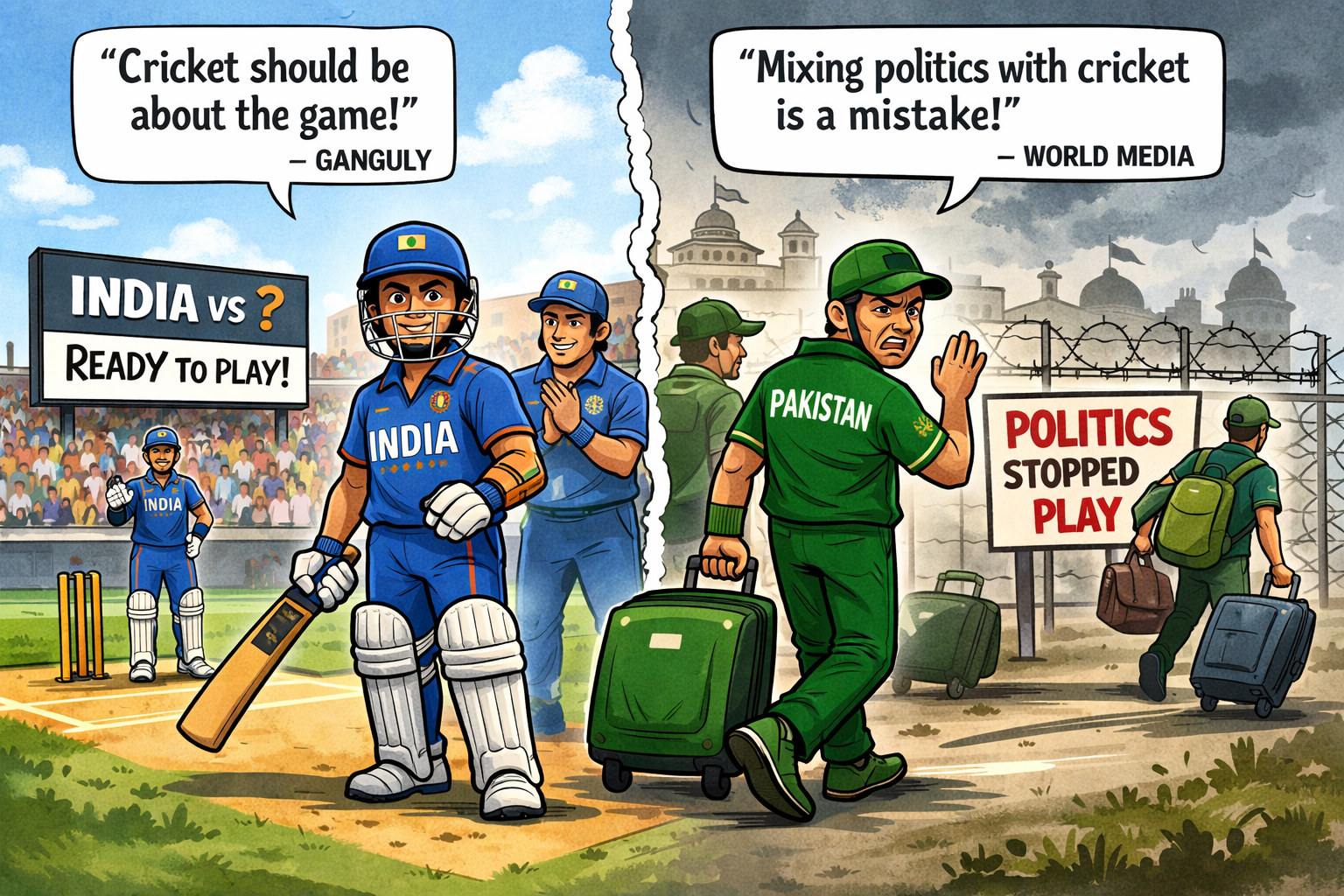
India arrived ready. Pads strapped, minds clear, eyes fixed on the game. Pakistan stayed away—not because of rain, not because of injury, but because of a decision taken far from the dressing room.
And that difference matters.
India’s Stand: Play the Game, Respect the Game
India’s position has been consistent and unmistakable:
Cricket should not be held hostage to political discomfort.
Over the years, India has travelled, competed, and hosted under strict ICC frameworks, trusting international cricket’s governing body rather than bending the rules to convenience. Former Indian captain Sourav Ganguly has often emphasized that players prepare to compete, not to protest, a sentiment echoed repeatedly in Indian cricketing circles.
Another former Indian cricketer, speaking on global broadcasts, summed it up plainly:
“When you enter an ICC tournament, you agree to the rules. You don’t pick opponents like a playlist.”
India did not ask for special venues.
India did not demand exemptions.
India showed up—because that is what sport demands.
Pakistan’s Boycott: Protest or Pretext?
Pakistan’s refusal to play India has been framed as a political statement, but many in the cricketing world see it as a selective stand, one that blurs the line between principle and pressure.
Former Pakistan captain Wasim Akram, in past discussions on similar issues, has warned that mixing politics with cricket ultimately hurts players and fans, not policymakers. World cricket remembers his view clearly: cricketing decisions should be taken by cricket boards—not dictated by external forces.
Global media outlets, from the UK to Australia, have also questioned the logic behind such boycotts. One leading British sports publication described the move as “symbolic defiance with real sporting costs”, while an Australian daily noted that “withdrawing from marquee fixtures damages the tournament more than it delivers any diplomatic message.”
In short, the world is watching—and it is unconvinced.
Is the Reason Relevant in an ICC Tournament?
This is the heart of the debate.
An ICC World Cup is not a bilateral series.
It is not a friendly.
It is a contract—sporting, commercial, and ethical.
Former England captain Michael Vaughan has repeatedly argued that once a team commits to an ICC event, non-participation undermines the integrity of the competition. The rules exist precisely to prevent selective play.
If every nation begins choosing whom to play and whom to avoid, the idea of a “World Cup” collapses into chaos.
India understands this. That is why it plays.
Should the ICC Take Action?
From a regulatory standpoint, the ICC cannot afford silence.
If Pakistan’s boycott stands without consequence, it sets a precedent—one that could encourage future withdrawals based on politics rather than principle. Many former international cricketers believe that financial penalties or points forfeiture are not punishments, but safeguards for the sport.
As one senior cricket analyst in international media put it:
“The ICC doesn’t exist to negotiate geopolitics. It exists to protect cricket.”
India, by adhering to the framework, strengthens its moral position. Pakistan, by stepping away, risks scrutiny—not sympathy.
What Pakistan Stands to Lose
The losses are not abstract; they are immediate and measurable.
- Two vital points—handed to India without a ball bowled
- Tournament momentum—broken before it could begin
- Global goodwill—strained among fans and boards alike
- Financial impact—as India–Pakistan matches are the economic engine of world cricket
Former ICC officials have openly acknowledged that no fixture generates more revenue, viewership, or global engagement than India vs Pakistan. Walking away from it is not just a sporting loss—it is a strategic one.
And history is unforgiving to teams that abandon the field.
Conclusion: The Team That Played Won More Than Points
India didn’t need a boycott to prove its stature.
It proved it by being present.
By choosing cricket over controversy, India reinforced an idea the world still believes in: that sport, when played honestly, can rise above politics—even when politics refuses to rise above sport.
As the tournament moves on, scoreboards will change. Records will fall. New heroes will emerge.
But this moment will linger.
Because when one team walked away,
the other stood firm—
and let the game speak.