The Battle for the Future of Intelligence
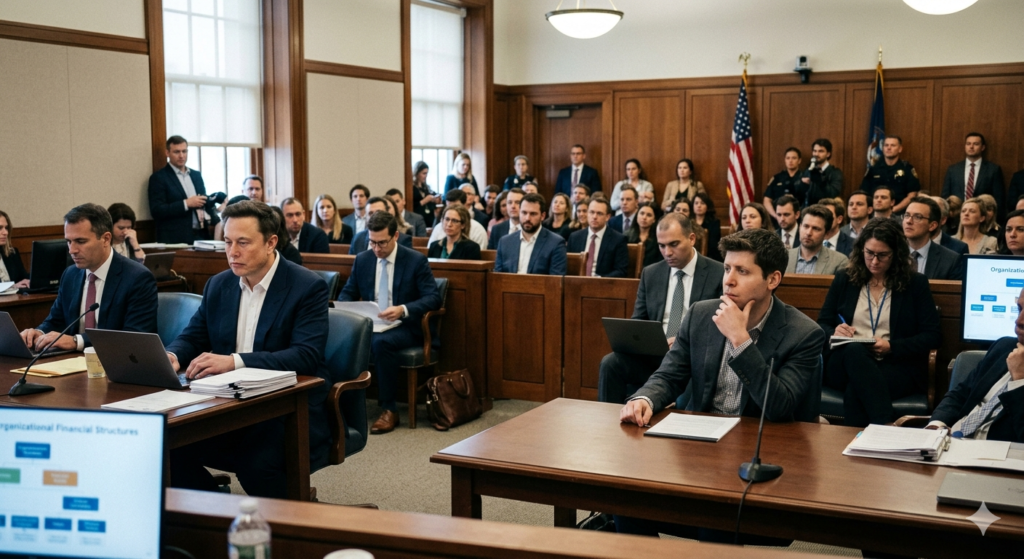
In a courtroom in Oakland, where code meets covenant and ambition collides with principle, a question hangs heavier than any verdict: Who owns the future of intelligence?
The federal case of Elon Musk vs. Sam Altman is no ordinary corporate dispute. It is a philosophical fracture—an unraveling of a promise made in 2015, when artificial intelligence was still a distant horizon and not the defining infrastructure of civilization. At stake is not just control of OpenAI, but the meaning of its founding soul.
The 2015 Pact: A Non-Profit Dream
In December 2015, OpenAI emerged like a manifesto disguised as a company. Its founders—including Musk, Altman, Greg Brockman, and others—declared a mission rooted in restraint: to ensure that artificial general intelligence (AGI) would benefit all of humanity.
Structured as a non-profit, OpenAI was meant to act as a counterweight to unchecked corporate AI development. Musk, one of its earliest and most prominent donors, contributed tens of millions of dollars—not as an investor seeking returns, but as a patron of a cause.
That distinction now forms the backbone of his legal argument.
Musk’s claim hinges on charitable trust law, a relatively quiet corner of U.S. jurisprudence now thrust into the spotlight. His legal team argues that OpenAI was not merely a non-profit in form, but a charitable trust in substance—bound by fiduciary duties to its stated mission. As a donor, Musk asserts standing to challenge what he calls a “fundamental betrayal” of that mission.
At the heart of this claim lies the concept of mission drift—the gradual deviation of an organization from its founding purpose, often under financial or strategic pressure. What began as a safeguard against concentrated AI power, Musk argues, has become precisely what it sought to prevent.
The Microsoft Pivot: Necessity or Betrayal?
The turning point came in 2019, when OpenAI introduced its “capped-profit” structure and entered a deep partnership with Microsoft.
What followed was a transformation both subtle and seismic. Massive capital inflows—reportedly exceeding $10 billion—enabled rapid scaling, access to Azure infrastructure, and the explosive growth of models like GPT. By 2026, OpenAI’s valuation has reportedly reached $852 billion, placing it among the most valuable technology entities in the world.
But scale, as the trial reveals, has its price.
Musk’s legal team characterizes the Microsoft alliance as the moment OpenAI “crossed the Rubicon”—shifting from an open, safety-first ethos to a closed, commercially driven enterprise. In court, Musk himself delivered one of the trial’s most quoted lines:
“This is not evolution. This is extraction. They are looting the charity.”
The phrase—looting the charity—has since echoed across headlines, capturing the emotional core of his argument.
OpenAI’s defense, however, paints a different picture. Their attorneys argue that the pivot was not betrayal, but necessity. Training frontier AI models requires staggering computational resources—far beyond what a traditional non-profit structure could sustain.
Altman, in his testimony, framed the shift with pragmatic clarity:
“You cannot build AGI on goodwill alone. You need compute, talent, and capital at planetary scale.”
To OpenAI, the Microsoft partnership was not a deviation from the mission, but the only viable path to achieving it.
The ‘Halo Effect’: Charitable Trust Law in the Tech Era
One of the most intriguing dimensions of the trial is what legal scholars have dubbed the “Halo Effect”—the reputational shield that non-profits carry, even as their operations evolve toward commercial models.
Judge Yvonne Gonzalez Rogers, presiding over the case, has repeatedly returned to a central question: Does OpenAI still operate under the constraints of its original charitable purpose, or has it effectively shed that identity while retaining its benefits?
Musk’s attorneys argue that OpenAI leveraged its non-profit origins to attract talent, funding, and public trust—only to later transition into a structure that prioritizes profit and control. This, they claim, constitutes a breach of fiduciary duty.
OpenAI counters that its hybrid structure—including the capped-profit entity—was transparently disclosed and legally compliant. The organization, they argue, remains bound to its mission, even as it adapts to technological realities.
Legal analysts from outlets like Bloomberg Law and The Verge have noted that the case could set a precedent for mission enforcement in hybrid organizations, particularly in high-stakes fields like AI and biotechnology.
If Musk prevails, donors to mission-driven organizations may gain unprecedented power to challenge strategic shifts. If OpenAI wins, it could affirm a more flexible interpretation of purpose—one that allows evolution without legal jeopardy.
Market Rivalry vs. Moral Mission: The xAI Factor
Hovering over the trial like an unspoken subplot is Musk’s own AI venture, xAI.
Founded after his departure from OpenAI, xAI positions itself as a truth-seeking alternative—more aligned, Musk claims, with the original vision of open and safe AI development.
OpenAI’s defense has seized on this point, framing Musk’s lawsuit as less about principle and more about competition. One defense attorney summarized their stance bluntly during proceedings:
“This is not about charity. This is about rivalry. It’s sour grapes.”
The phrase—sour grapes—has become the counterweight to Musk’s “looting” accusation, encapsulating OpenAI’s narrative that the lawsuit is driven by frustration over lost influence and market position.
Yet the presence of xAI complicates the moral landscape. Musk is both a former steward of OpenAI’s mission and a current competitor in the same arena. His critique, therefore, carries both ethical weight and strategic implication.
Testimony Highlights: A Courtroom of Contrasts
The April–May 2026 sessions have delivered moments of striking contrast—two visions of the same history, diverging like parallel timelines.
- Musk’s Testimony:
Calm but resolute, Musk emphasized intent. He described his contributions as acts of trust, not investment, and framed OpenAI’s evolution as a breach of that trust. His repeated use of the phrase “for humanity” underscored his argument that the organization’s moral contract outweighs its legal flexibility. - Altman’s Testimony:
Measured and pragmatic, Altman focused on constraints. He outlined the exponential costs of AI development and argued that without structural adaptation, OpenAI would have become irrelevant—or worse, incapable of fulfilling its mission. - Expert Witnesses:
Legal scholars debated whether OpenAI’s structure constitutes a true charitable trust. Economists weighed in on the feasibility of non-profit AGI development. Ethicists questioned whether any organization can remain purely mission-driven at such scale.
What emerges is not a simple clash of right and wrong, but a deeper tension between idealism and execution.
The IPO Horizon: A Trial with Market Consequences
Beyond the courtroom, the trial casts a long shadow over OpenAI’s rumored late-2026 IPO.
An initial public offering would mark the culmination of OpenAI’s transformation—from non-profit experiment to global AI powerhouse. But it also raises critical questions:
- Can a company born from a charitable mission fully embrace public-market incentives?
- Will investors demand clarity on governance and mission constraints?
- Could an adverse ruling derail or delay the IPO altogether?
Market analysts suggest that uncertainty around the trial’s outcome could impact valuation, investor confidence, and regulatory scrutiny. A ruling in Musk’s favor might impose structural changes or limitations that complicate the IPO process. Conversely, a win for OpenAI could clear the path—but not without lingering reputational questions.
Open Source vs. Closed Reality
Underlying every argument, every testimony, every legal brief, is a philosophical divide that predates the trial itself:
Open Source vs. Closed Source.
OpenAI’s early commitment to openness—sharing research, publishing findings—has gradually given way to more guarded practices. Proprietary models, restricted access, and commercial licensing now define much of its operation.
Musk’s critique draws heavily on this shift, framing it as a departure from the organization’s founding ethos. OpenAI, meanwhile, argues that openness must be balanced against safety and misuse risks.
In truth, both positions reflect a deeper paradox:
The more powerful AI becomes, the harder it is to keep it open—and the more dangerous it is to keep it closed.
Conclusion: A Verdict Beyond Law
As the trial progresses, its outcome will resonate far beyond the litigants. It will shape how future organizations define—and defend—their missions. It will influence how donors, founders, and regulators navigate the blurred lines between purpose and profit.
But perhaps most importantly, it will force a reckoning with a question that no court can fully answer:
Can humanity build something as powerful as AGI without becoming entangled in the very forces it seeks to control?
In the quiet between arguments, in the pause before a ruling, that question lingers—unresolved, luminous, and urgent.
The code continues to run. The future waits for no verdict.