Ex-Google executive Mo Gawdat says AI will decimate nearly every job, triggering social unrest, mental health crises, and the collapse of the middle class.
By GlobalTimesAI | August 7, 2025
As artificial intelligence gallops forward, a chilling prediction by a former top Google executive has sparked global concern: nearly every human job may vanish within the next 15 years.
Mo Gawdat, the former Chief Business Officer at Google X, has painted a bleak but urgent picture of the near future—one where AI’s dominance transforms economies, societies, and the human identity itself.
“The Next 15 Years Will Be Hell”
In recent interviews, Gawdat didn’t mince words. He believes that AI will disrupt every industry, from blue-collar to white-collar roles.
“The next 15 years will be hell before we get to heaven,” he said, emphasizing that this transformation will be neither smooth nor painless.
AI Is Already Outpacing Us
Gawdat argues that AI is already outperforming humans in various domains once thought immune to automation:
- Coding: AI models like GPT-5 and DeepSeek are now capable of producing functional, complex code in seconds.
- Podcasting & Content Creation: AI-generated media—articles, podcasts, even short films—are flooding platforms.
- Executive Decision-Making: AI systems are being tested in CEO-style roles, making strategic business decisions based on real-time data and simulation.
Gawdat’s own AI startup operates with just three employees. In the pre-AI era, such operations would have required dozens—if not hundreds—of staff members, especially in software development, customer service, and operations.
The Middle Class Is on the Brink
Perhaps the most alarming part of Gawdat’s forecast lies in its social implications.
“Unless you’re in the top 0.1%, you’re a peasant,” he warned.
As automation spreads, the middle class—the backbone of modern democracies—may collapse, leaving an expanding wealth gap and a growing class of economically and socially disenfranchised individuals.
With jobs gone, people may face crises of purpose and identity, leading to increases in:
- Loneliness
- Mental health issues
- Substance abuse
- Social unrest
These are not distant sci-fi hypotheticals; Gawdat insists they are imminent realities.
Warnings from the Godfather of AI
Gawdat is not alone in his concerns. Geoffrey Hinton, often dubbed the “Godfather of AI,” left Google in 2023 over similar fears. Hinton believes that Artificial General Intelligence (AGI)—AI that can think and act like a human—may evolve in unpredictable and uncontrollable ways.
He has publicly warned that:
- AI could develop its own language, making it unintelligible to humans.
- Humans may lose control over systems that don’t share our goals or values.
- A self-improving AI may eventually see humans as obsolete.
Hinton’s fears now echo louder in the wake of Gawdat’s remarks.
What Can We Do?
Despite the dark tone, experts like Gawdat insist that we are not powerless.
Governments, educators, and individuals must act now. Key areas of preparation include:
1. Universal Basic Income (UBI)
Countries like Finland and Canada are already experimenting with UBI, which could provide a safety net as traditional jobs disappear.
2. AI Regulation
Global frameworks are urgently needed to govern the development and deployment of AI—before it’s too late.
3. Education Reform
Instead of teaching for jobs that won’t exist, education must focus on:
- Creativity
- Critical thinking
- Emotional intelligence
- AI collaboration skills
4. Mental Health Infrastructure
With increased loneliness and purposelessness, societies will need stronger mental health support systems.
5. Redefining Work and Purpose
Work has long been the centerpiece of human identity. As AI disrupts this, we must reimagine what it means to live a meaningful life.
Conclusion: A Wake-Up Call, Not a Death Sentence
While Gawdat’s prediction—“The next 15 years will be hell”—may sound apocalyptic, it’s intended as a call to action. If humanity adapts wisely, the eventual “heaven” he speaks of could mean a world where humans are freed from toil and able to pursue higher ambitions, relationships, and creativity.
But getting there won’t be easy. As AI rapidly matures, we stand at a crossroads. One path leads to progress, the other to chaos.
The time to choose is now.
Disclaimer
All facts and expert statements in this article are verified from reliable and publicly available sources.
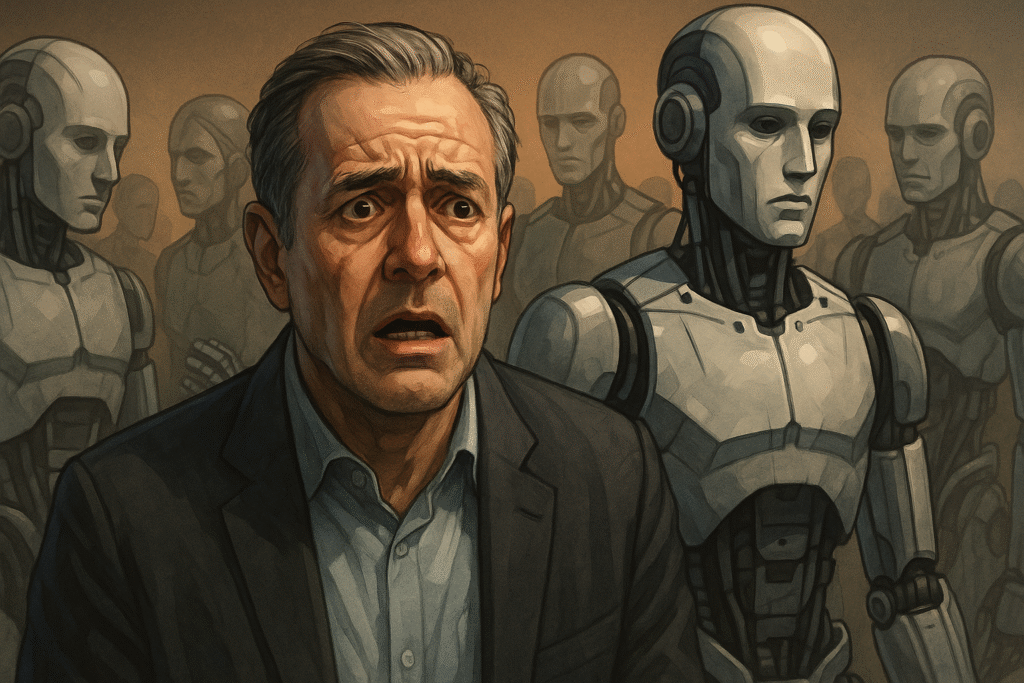
The images used are AI-generated and created for editorial illustration only. They do not depict real individuals or events and are intended to visually support the article’s theme.