Demis Hassabis: From DeepMind’s Dream to the Nobel Prize

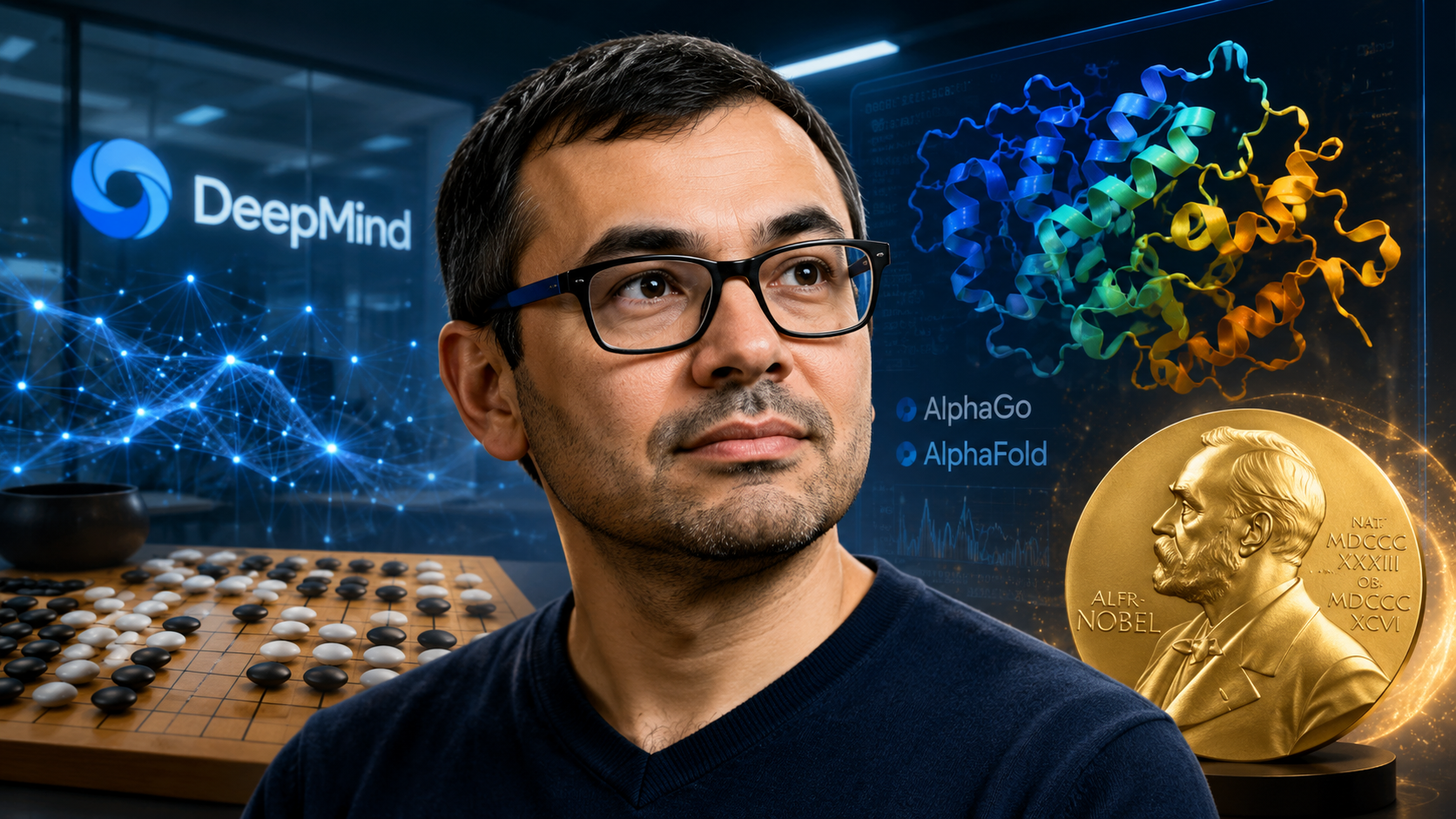
A simple story of a chess-loving boy who built one of the world’s most powerful AI labs and used it to change science
Demis Hassabis, born in London on 27 July 1976. At first he appeared like any other curious child. But very early on, one thing was obvious: his mind loved patterns.
Demis was sitting in front of a chessboard, while other children were busy with ordinary games. He began playing chess at a very young age. His first school of ideas was the board. Every piece was purposeful. Every move had consequences. Every mistake came with a lesson.
For Demis chess was not only a game. It was a small world where he could find out how the mind works.
Chess had taught him patience. He learned to plan. He learned to speculate on what might happen next. Slowly, he became very good at it. As a teenager, he became one of the strongest young chess players in the world for his age.
Then something important happened.
With the money he won from chess competitions, he bought his first computer. That computer changed his life.
To many people, a computer was only a machine. To Demis, it was a door. He wanted to know what it could do. He started learning programming by himself. He read books. He tested ideas. He made mistakes. Then he fixed them.
Very soon, he began to ask a big question:
Can a machine learn like a human?
This question stayed with him for many years.
As he grew older, Demis entered the world of video games. He worked on games and helped create successful titles like Theme Park. He was still very young, but he was already building digital worlds where people could play, plan and make decisions.
Games taught him another lesson. A game is not just about fun. A game is a system. It has rules. It has choices. It has rewards and punishments. It can teach a person how to think.
For Demis, games became a training ground for intelligence.
But he did not stop there. He wanted to understand the human brain itself. So he studied computer science, then moved into neuroscience. He wanted to know how memory works, how imagination works and how people use past experience to prepare for the future.
This was the hidden foundation of his later work. He was not only trying to build smart machines. He was trying to understand intelligence itself.
Then, in 2010, Demis Hassabis took the biggest step of his life.
He co-founded DeepMind in London with Shane Legg and Mustafa Suleyman.
DeepMind was not a normal technology company. Its goal was very bold: understand intelligence, build advanced artificial intelligence and then use it to solve hard problems in the world.
In the beginning, DeepMind trained AI systems to play old video games. The AI was not given detailed instructions like a normal program. It looked at the screen. It tried moves. It failed. It learned. Then it became better.
It was almost like watching a child learn a game.
This was the magic of DeepMind. Demis did not want machines that only followed orders. He wanted machines that could learn from experience.
Soon, big technology companies noticed DeepMind. Facebook was interested. Google was also interested.
Demis chose Google.
Why?
Because DeepMind needed more than money. It needed huge computing power. It needed world-class researchers. It needed a company that could support a long scientific mission. Google had that strength.
There was also another reason. Demis cared about the safety and ethics of AI. He knew that powerful AI could help the world, but it could also become dangerous if used without care. Google gave DeepMind the scale and support it needed to continue its work.
In 2014, Google bought DeepMind.
After this, DeepMind became stronger. But the world still did not fully understand how important it would become.
Then came AlphaGo.
Go is an ancient board game. It looks simple, but it is one of the most difficult games in the world. For years, experts believed that computers would not be able to beat the best human Go players for a long time.
Chess had already been beaten by machines, but Go was different. It needed deep judgment. It needed intuition. It needed a feeling for the board.
DeepMind decided to try.
They built an AI system called AlphaGo.
First, AlphaGo defeated a European Go champion. That was a big moment. But the real test came in 2016, when AlphaGo played against Lee Sedol, one of the greatest Go players in history.
People around the world watched the match.
It felt like more than a game. It felt like human intelligence was facing a new kind of machine intelligence.
AlphaGo won the first game. People were shocked.
Then came the second game. In that game, AlphaGo made a move that became famous: Move 37.
At first, many experts thought the move was strange. Some even thought it was a mistake. It did not look like a normal human move. But later, people understood that AlphaGo had seen something humans had missed.
That move changed everything.
It showed that AI was not only copying humans. It could find new ideas. It could surprise even the masters.
AlphaGo defeated Lee Sedol by 4 games to 1.
Lee Sedol won one game, and that victory was also beautiful. It showed the strength of the human spirit. But the final result was clear. AI had reached a new level.
For Demis Hassabis, AlphaGo was a proud moment. But games were never the final destination.
He wanted AI to help science.
And this dream led to AlphaFold.
For many years, scientists had struggled with a difficult problem in biology: how proteins fold.
Proteins are very important for life. They are like tiny machines inside the body. Their shape decides what they do. If scientists can understand the shape of a protein, they can better understand diseases and medicines.
But finding a protein’s shape was very hard. It could take months or even years in a laboratory.
DeepMind used AI to help solve this problem.
They created AlphaFold.
AlphaFold could predict protein structures with amazing accuracy. This was a huge breakthrough. Scientists around the world suddenly had a new tool. They could study diseases faster. They could understand biology better. They could begin research from a stronger starting point.
AlphaFold was not just another AI project. It was a gift to science.
It showed that artificial intelligence could do more than play games, write text or recognize images. It could help us understand life itself.
Then, in 2024, Demis Hassabis received one of the greatest honors in the world.
He won the Nobel Prize in Chemistry, along with John Jumper, for their work on protein structure prediction through AlphaFold.
This was a historic moment.
A man who began with chess, then built games, then studied the brain, then created DeepMind, had finally used AI to solve one of science’s biggest problems.
The Nobel Prize proved that Demis’s journey was not only about technology. It was about knowledge. It was about using machines to help humans see what was hidden.
Elon Musk also became connected to Demis’s story. Musk has often warned that powerful AI can be dangerous if it is not controlled. He reportedly invested in DeepMind partly because he wanted to understand and watch the direction of advanced AI.
There is also a well-known story about a conversation between Musk and Hassabis. Musk believed that humans should go to Mars to protect civilization. Hassabis reportedly replied that if dangerous AI became a problem, even Mars might not be safe because AI could spread through communication systems.
This shows something important about Demis. He is not careless about AI. He understands both its promise and its danger.
His life has a simple but powerful pattern.
Chess taught him to think ahead.
Video games taught him how systems work.
Neuroscience taught him how the brain imagines and remembers.
DeepMind gave him a place to build learning machines.
AlphaGo showed that AI could surprise humans.
AlphaFold showed that AI could help science.
The Nobel Prize showed that the world had understood the value of his work.
Demis Hassabis’s story is not only the story of a brilliant scientist. It is the story of a child who kept asking bigger questions.
First, he asked how to win a chess game.
Then he asked how to build a thinking machine.
Then he asked how AI could help humanity.
That is what makes his story special.
He did not create AI only to make machines powerful. He wanted to use AI to increase human understanding.
The boy who once looked at a chessboard and searched for the next move is now helping the world search for the next step in science.
From DeepMind to AlphaGo.
From AlphaGo to AlphaFold.
From AlphaFold to the Nobel Prize.
Demis Hassabis’s journey feels like a reminder that the biggest revolutions often begin quietly.
Sometimes, they begin with a child, a chessboard and a question that refuses to die.
Disclaimer:
This article is written for informational, educational and editorial purposes only. It is based on publicly available information about Demis Hassabis, DeepMind, AlphaGo, AlphaFold and the Nobel Prize in Chemistry. The story has been written in simple narrative language to help readers understand his journey from AI research to scientific recognition.
While every effort has been made to keep the information accurate, readers are advised to refer to official sources such as Google DeepMind, The Nobel Prize website and verified scientific publications for detailed and technical information. This article does not claim to represent the personal views of Demis Hassabis, Google DeepMind, the Nobel Foundation or any related organization.
The featured image used with this article is AI-generated and created only for editorial and illustrative purposes. It is not a real photograph of an actual event, award ceremony or official DeepMind/Nobel moment. The image symbolically represents Demis Hassabis’s journey from DeepMind, AlphaGo and AlphaFold to Nobel Prize recognition.
