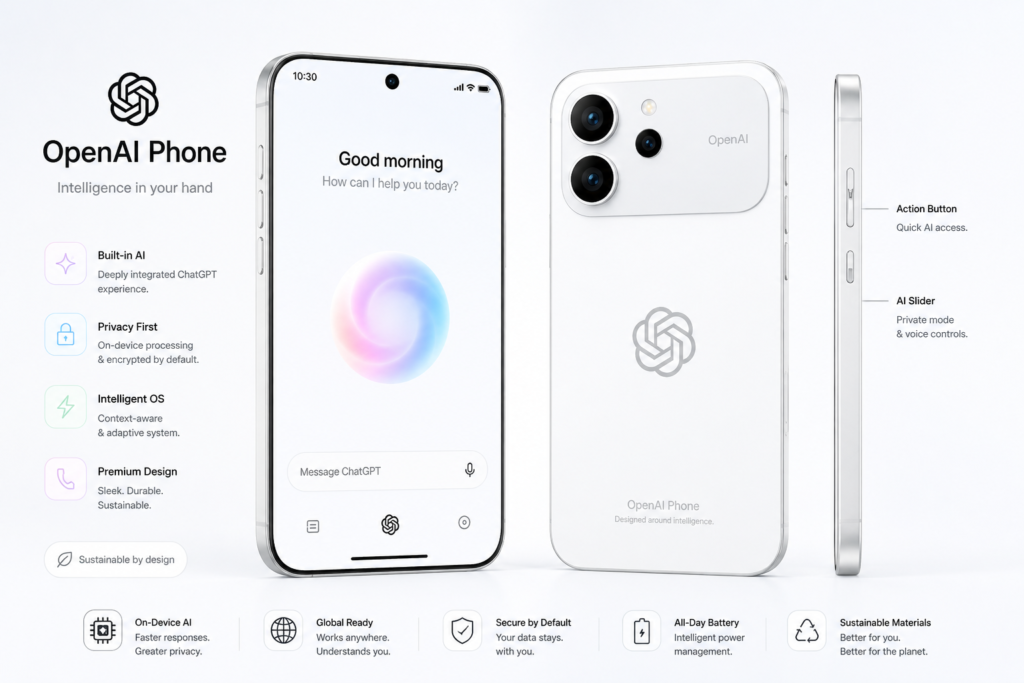
Analyst Ming-Chi Kuo confirms mass production moved up to H1 2027. With MediaTek as sole chip supplier and 30 million units projected, OpenAI is making its boldest hardware bet yet.
OpenAI, the Sam Altman-led artificial intelligence powerhouse behind ChatGPT, is moving faster than anyone anticipated in the smartphone hardware space. Trusted Apple analyst Ming-Chi Kuo — whose supply-chain track record spans two decades — has confirmed that OpenAI has pulled forward its first AI-agent smartphone from a previously expected 2028 window to mass production in the first half of 2027. The strategic pivot carries enormous implications: for smartphone makers, chip suppliers, and the broader AI ecosystem.
Why now? The IPO clock is ticking
The accelerated timeline is not merely a product decision — it is a financial one. OpenAI is reportedly planning a high-profile IPO by the end of 2026 or early 2027, and a tangible, shipping hardware product would substantially strengthen its market narrative. Investors increasingly want to see AI companies demonstrate direct consumer touchpoints beyond software subscriptions. A phone — even a pre-revenue one in production — signals seriousness about building an end-to-end AI platform stack.
According to Kuo’s supply-chain analysis, OpenAI’s acceleration is also a response to competitive pressure. Multiple rivals are building what analysts are calling “AI-native” or “AI-agent” phones — devices where an AI layer operates persistently across all user actions, rather than being bolted on as an assistant feature.
Hardware blueprint: MediaTek Dimensity 9600 on TSMC 2nm
Earlier reports speculated that both Qualcomm and MediaTek were in contention for the processor contract. Kuo’s latest analysis resolves that: MediaTek is now confirmed as the sole chip supplier. The expected processor is a customised version of the Dimensity 9600, which is slated to be built on TSMC’s cutting-edge 2nm process node, arriving in late 2026 — just in time to feed OpenAI’s H1 2027 production ramp.
The 2nm node is significant. It offers a substantial improvement in energy efficiency and raw compute density versus the current 3nm generation — critical for running on-device AI inference without draining a battery in hours. Running large language model (LLM) tasks locally, rather than routing every query to the cloud, is a core design requirement for any credible AI-agent phone.
“MediaTek’s Dimensity 9600 built on TSMC 2nm could be a genuine differentiator. If OpenAI can leverage on-device inference at this scale, they bypass the latency and privacy concerns of cloud-only AI — that’s a compelling pitch to consumers.”— Supply chain analyst commentary, corroborated via Ming-Chi Kuo’s Substack dispatch, May 2026
Who does OpenAI compete with?
The AI-agent phone category is becoming crowded at remarkable speed. Here is how the competitive landscape shapes up:
Apple
Apple Intelligence, on-device models via A18 chip, Siri overhaul. Deeply entrenched ecosystem advantage.
Gemini Nano on Pixel 9 series. Android-wide AI integration gives Google the broadest reach.
Samsung
Galaxy AI features across S and Z series. Partnerships with both Google and its own Gauss model.
Humane / Rabbit
AI-first startups that pioneered the concept but struggled with execution and form factor.
Meta
Meta AI deeply embedded in Ray-Ban glasses and WhatsApp, eyeing further hardware ambitions.
OpenAI’s advantage, should it execute well, is brand recognition at the AI layer. ChatGPT has over 400 million weekly active users as of early 2026. Turning that software loyalty into hardware attachment is the core thesis — and it mirrors Apple’s own early iPhone strategy of extending ecosystem lock-in to a physical device.
Expert opinion: bold bet or hardware graveyard?
Industry observers are divided. Optimists argue that OpenAI is uniquely positioned: it owns the underlying models, has the consumer brand, and now has the supply-chain relationships to ship at scale. A phone that natively integrates GPT-5 or its successors — without API throttling or third-party abstractions — could offer a genuinely different user experience.
“If OpenAI can make the AI agent the primary UI — not a feature but the operating layer — they have a chance to leapfrog rather than catch up. The question is whether consumers are ready to buy a phone because of its AI, rather than its camera or brand.”— Ben Thompson, Stratechery (paraphrased from ongoing AI hardware analysis, 2025–2026)
Skeptics point to the graveyard of hardware ventures by software-first companies: Google Glass, the Amazon Fire Phone, Microsoft’s Surface Phone, and most recently Humane’s AI Pin. Each promised a paradigm shift; none delivered at consumer scale. The recurring lesson: hardware is unforgiving, and distribution is everything.
However, the 30 million unit projection for 2027–2028 suggests OpenAI is not dabbling — it is planning for a mass-market launch from day one, likely through carrier partnerships and aggressive pricing strategies, possibly subsidized by an OpenAI subscription model.
What the future looks like
If the ChatGPT phone ships on schedule and resonates with consumers, the implications extend well beyond OpenAI’s balance sheet. It could trigger a permanent bifurcation in the smartphone market: traditional feature-first devices on one side, and AI-agent-first platforms on the other. Carriers, app developers, and enterprise software vendors would all need to rethink how they reach users. The phone could also serve as OpenAI’s most potent data collection vehicle — with explicit consent mechanisms — feeding model training in ways that cloud API usage alone cannot replicate.
TSMC’s capacity for 2nm chips in late 2026 will be a key gating factor. Apple’s A20 and other flagship chips will compete for the same fabs, meaning any supply disruption could push OpenAI’s timeline back toward its original 2028 estimate.
Conclusion
OpenAI’s fast-tracked AI smartphone is the most consequential hardware announcement in the AI space since Apple’s M-series silicon. By locking in MediaTek’s 2nm Dimensity 9600 and targeting 30 million units across 2027–2028, OpenAI is signalling that the future of AI is not just in the cloud — it is in your pocket. The IPO timeline adds urgency, but the product vision is what will ultimately determine success. Whether the ChatGPT phone becomes the iPhone moment for AI, or joins the long list of ambitious hardware failures, will depend on execution, pricing, and whether consumers are finally ready to buy AI first and phone second. The next 18 months will be decisive.
- Ming-Chi Kuo, Substack — Supply chain analysis on OpenAI smartphone production timeline, May 2026
- The Information — OpenAI hardware ambitions and IPO strategy reporting, 2025–2026
- MediaTek — Dimensity 9600 product roadmap, confirmed via TSMC 2nm node announcements
- Stratechery (Ben Thompson) — AI hardware paradigm analysis, ongoing
- Bloomberg Technology — OpenAI valuation and IPO timeline coverage, 2025–2026
- GSMArena / AnandTech — Chip benchmarking and 2nm process node technical overview