For years, the story of artificial intelligence sounded like a one‑directional march from Silicon Valley outward. American giants—OpenAI, Google, Microsoft, Nvidia—seemed destined to own the future, pushing out ever‑larger models powered by ever‑scarcer chips. But as we move through 2026, that narrative is cracking. A very different strategy is taking shape across the Pacific, where China is quietly re‑writing the rules of the game.
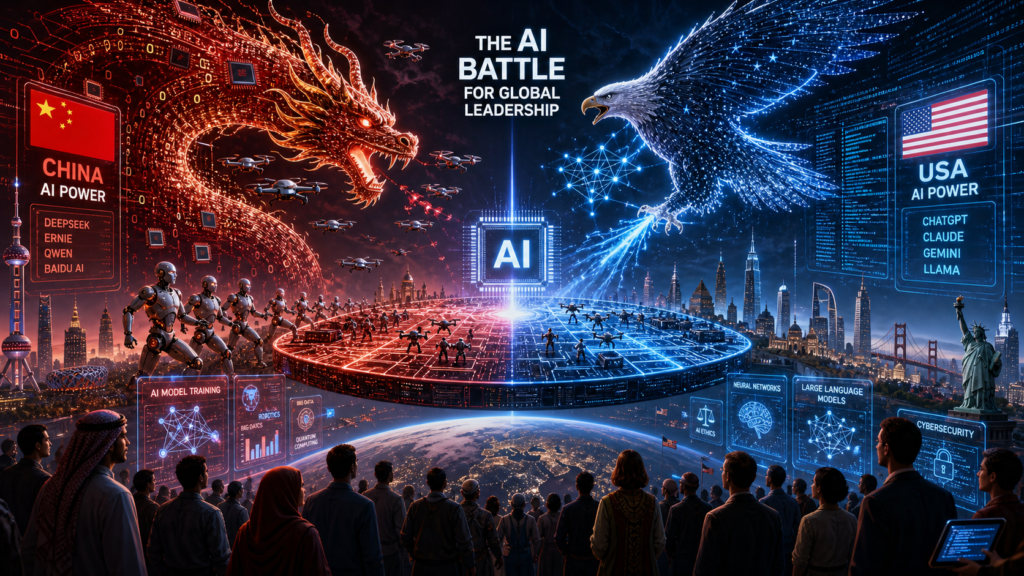
Instead of trying to out‑muscle the United States at the absolute frontier, Beijing and its tech champions are launching a flanking attack—targeting cost, scale, and real‑world deployment. American firms still dominate the bleeding edge of research. China’s bet is that this is no longer enough. In an AI world that will be defined by who can spread intelligence through their entire economy—and export it to others—“good enough and cheap” may be the most powerful weapon of all.
Welcome to the silicon showdown: a slow‑burning technology war where chips, open‑source models, and factory robots matter as much as flashy demos.
DeepSeek vs GPT‑5.5: The New Flagship Duel
Every great rivalry needs its symbols. In 2026, one duel has become shorthand for the broader US–China AI contest: DeepSeek V4 versus GPT‑5.5.
On paper, the American contender looks unsurprising. GPT‑5.5, from OpenAI and its US ecosystem, is the archetypal “frontier” model: massive, closed, and trained on oceans of data and computation. It is the aircraft carrier in the harbor—heavy, powerful, and expensive to build and maintain.
DeepSeek V4, born in China, represents something more unexpected. It is built as a mixture‑of‑experts model with roughly 1.6 trillion parameters, but only a small fraction of them activate for any given token. That approach slashes the cost of running the model while preserving impressive capabilities in reasoning, coding, and multi‑step logic. Independent analyses have found DeepSeek’s performance hovering near GPT‑5.5 across many benchmarks, despite using far fewer active parameters per inference.
More importantly, DeepSeek has done something US leaders have not: it has released open weights. In practice, that means companies, governments, and startups can run DeepSeek on their own infrastructure, tune it to their own data, and avoid paying perpetual rent to a foreign platform. For countries wary of political pressure or data dependency, that self‑hosting option is not a technical detail; it is a geopolitical safety valve.
One technical analyst described DeepSeek V4 as “the antithesis of OpenAI’s brute‑force approach… a masterclass in parameter efficiency and algorithmic optimization,” arguing that it proves “you don’t need infinite GPUs to build a world‑class model.” Another comparative review noted that DeepSeek achieves “near‑parity with GPT‑5.5… using a fraction of the active parameters during inference,” which translates directly into lower compute bills.
If GPT‑5.5 is the US aircraft carrier, DeepSeek is the Chinese missile swarm—cheaper, more numerous, and designed to exploit the vulnerabilities of a high‑cost adversary. The symbolism is hard to miss.
Beijing’s Playbook: Turn AI Into an Economic Weapon
DeepSeek did not emerge in isolation. It is part of a broader national project that has been building momentum for more than a decade and is now entering a new, more aggressive phase.
In its latest five‑year planning documents, Beijing has placed artificial intelligence at the center of its economic and industrial agenda. AI is not framed as a single sector, but as a horizontal capability to be fused into everything else: manufacturing lines, logistics networks, city management systems, financial services, healthcare, and even party governance. Official slogans talk about “AI+ industry,” “AI+ manufacturing,” “AI+ services”—a deliberate echo of past campaigns that transformed China into the world’s factory.
The new roadmap reads less like Silicon Valley’s obsession with “killer apps” and more like a blueprint for refitting an entire economy. It pairs AI with humanoid robots on factory floors, with brain–computer interface projects in medical labs, and with 6G and quantum communication in national infrastructure plans. The ambition is not to build the single smartest model, but to saturate the physical and digital environment with machine intelligence.
Crucially, the Chinese state has embraced open‑source AI as a strategic differentiator. While US frontier models gravitate toward closed APIs and proprietary platforms, Beijing is encouraging companies to release powerful models under permissive licenses, backed by domestic cloud and chip ecosystems. One industry analyst summed it up neatly: “China has meticulously analyzed this and chosen to position open‑source AI as a flagship strategy and a competitive edge over the United States.”
In other words, Washington is building walls—export controls, security alliances, restricted chips. Beijing is building markets—cheap models, open weights, large‑scale deployment programs. The battle is no longer just about who leads in raw capability; it is about whose system becomes the default choice for the rest of the world.
Choking the Chips, Changing the Weapons
If there is one domain where American policymakers feel they still hold a decisive advantage, it is hardware. The US and its allies dominate high‑end GPU design and control critical semiconductor manufacturing tools. Over the last few years, Washington has used that leverage to impose strict export controls on advanced chips bound for China, explicitly to slow its AI development.
The theory sounded persuasive: starve Beijing of Nvidia‑class accelerators, and its AI trajectory flattens.
The reality has been messier.
Unable to buy enough top‑tier US chips, Chinese firms have responded with a mix of improvisation and long‑term planning. Domestic champions have pushed out their own AI accelerators and are stringing them into ever‑larger clusters. The result is less elegant than a rack of the latest Nvidia hardware, but scale can compensate for individual chip weaknesses. Where one American GPU might do the work of several Chinese chips, China’s answer is simply: then we will build several.
At the same time, Beijing is pouring money into an indigenous semiconductor ecosystem—from design to fabrication—to make the country’s AI stack “resistant to US‑led export controls” over the medium term. It will take years to close the gap, but the political will is clear. As one policy analysis put it, export controls were supposed to slow China’s AI progress, yet Chinese firms are “finding creative paths forward,” and there is a growing risk that the pressure is accelerating, rather than preventing, domestic innovation.
There is also the question of loopholes. Some Chinese players have reportedly turned to foreign cloud providers or complex corporate structures to access compute outside the scope of controls. Others optimize their models, as DeepSeek has done, to get more capability out of fewer operations. Washington can restrict hardware, but it cannot easily restrict cleverness.
In military terms, the US is trying to enforce a blockade. China is responding by building its own shipyards, tunneling supply routes, and switching to lighter, more agile weapons.
Brains vs Bodies: Two Different Bets
A growing group of experts argues that the US and China are no longer racing on a single track. They are running parallel—sometimes intersecting—races with different goals.
On the American side, the focus remains on “brains”: ever‑more capable foundation models, powerful software tools, and cloud services that can automate a widening slice of digital work. This is the world of AI copilots, synthetic media, code generation, and knowledge work augmentation. The US is unmatched in this realm, thanks to its research universities, venture capital ecosystem, and concentration of talent.
China, by contrast, is pouring disproportionate effort into “bodies”—the physical instantiation of AI in robots, vehicles, drones, and industrial systems. Analysts point out that while the US is preoccupied with software agents that live on screens, China is racing ahead in AI‑driven robotics and automation that live in warehouses, ports, and factories.
One observer captured this divergence succinctly: the US is making its big bet on software capabilities and automating computer‑based tasks, while China is “heavily investing in AI‑driven robotics” and appears to be “outpacing its Western counterparts” in integrating AI with physical systems.
Seen from Beijing’s vantage point, this makes sense. China is aging. Its workforce is shrinking. Rising wages and geopolitical tensions are eroding the old advantage of cheap labor. If the country wants to remain the backbone of global manufacturing—or build new strategic industries in electric vehicles, batteries, and clean energy—it needs an army of tireless, programmable workers.
AI‑powered robots are that army.
In Chinese government roadmaps, you see this logic laid bare: “AI+ manufacturing,” “AI+ logistics,” “AI+ infrastructure” are not buzzwords but central pillars of economic security. Factory lines equipped with computer vision and predictive maintenance. Ports orchestrated by algorithms that choreograph trucks and container cranes. Power grids tuned by forecasting models instead of human dispatchers. This is the battlefield Beijing has chosen.
The Export War: Whose AI Runs the World?
Technology races are not just about who builds what at home; they are about whose tools everyone else uses.
On this front, China’s open, low‑cost models are a deliberate challenge to American dominance. For governments and companies in the Global South—or even in Europe—that cannot afford to pay premium subscription fees for US AI and worry about the political strings attached, Chinese alternatives look increasingly attractive.
Self‑hostable models like DeepSeek allow a finance ministry in Africa, a telecom in Southeast Asia, or a state‑owned enterprise in Latin America to run sophisticated AI locally, on their own data, with fewer legal and diplomatic complications. Combined with hardware financing, cloud services, or turnkey “smart infrastructure” projects, this creates a full political‑economic package: not just technology, but alignment and influence.
Some policy thinkers warn that the US risks repeating its 5G mistake. When Washington woke up to the strategic implications of Chinese telecom equipment, Huawei and its peers were already embedded across dozens of countries. The same could happen with AI: by the time America tries to slow or control the spread of Chinese models, they may already be wired into bureaucracies, logistics networks, and public services around the world.
One prominent analysis described this as a race to “build parallel AI civilizations.” In that framing, the United States and its allies maintain one AI stack—expensive, high‑performance, cloud‑centric, and tightly guarded. China builds another—open‑weight, cheaper, widely deployed, and bundled with physical infrastructure. Each block tries to pull other countries into its orbit.
The real competition, then, may not be between GPT‑5.5 and DeepSeek on some benchmark leaderboard. It will be between entire systems of technology, regulation, and values.
Who’s Really Winning?
Ask a pure technologist, and you will often hear the same answer: on the absolute frontier—chips, research breakthroughs, maximum‑capability models—the United States is still in the lead. Its research community is deeper, its top chips more advanced, and its giants more profitable.
But zoom out, and the picture looks less comfortable for Washington.
China is turning AI from a laboratory triumph into an economic weapon. It is building an ecosystem in which powerful models are not rare jewels but cheap tools woven into every layer of industry and governance. It is pairing those tools with a national push in robotics and automation that speaks directly to its economic needs. And it is using open‑source, low‑cost AI as a diplomatic offering to the rest of the world.
One US–China policy expert put it starkly: export controls and tech walls may slow Beijing in the short term, but they also “stimulate China’s own semiconductor development efforts,” making it more determined to build an independent stack. Another analyst warned that the West is “underestimating the long‑term impact of an AI ecosystem that is good enough and ubiquitous rather than best‑in‑class and scarce.”
In strategic terms, the US is betting that owning the smartest brain wins the war. China is betting that flooding the battlefield with millions of decent, loyal soldiers—algorithms, robots, embedded systems—matters more.
Both could be right. Which means the AI war is far from over.