Google Brings AI Image Detection to Search and Chrome: A New Shield Against Deepfakes

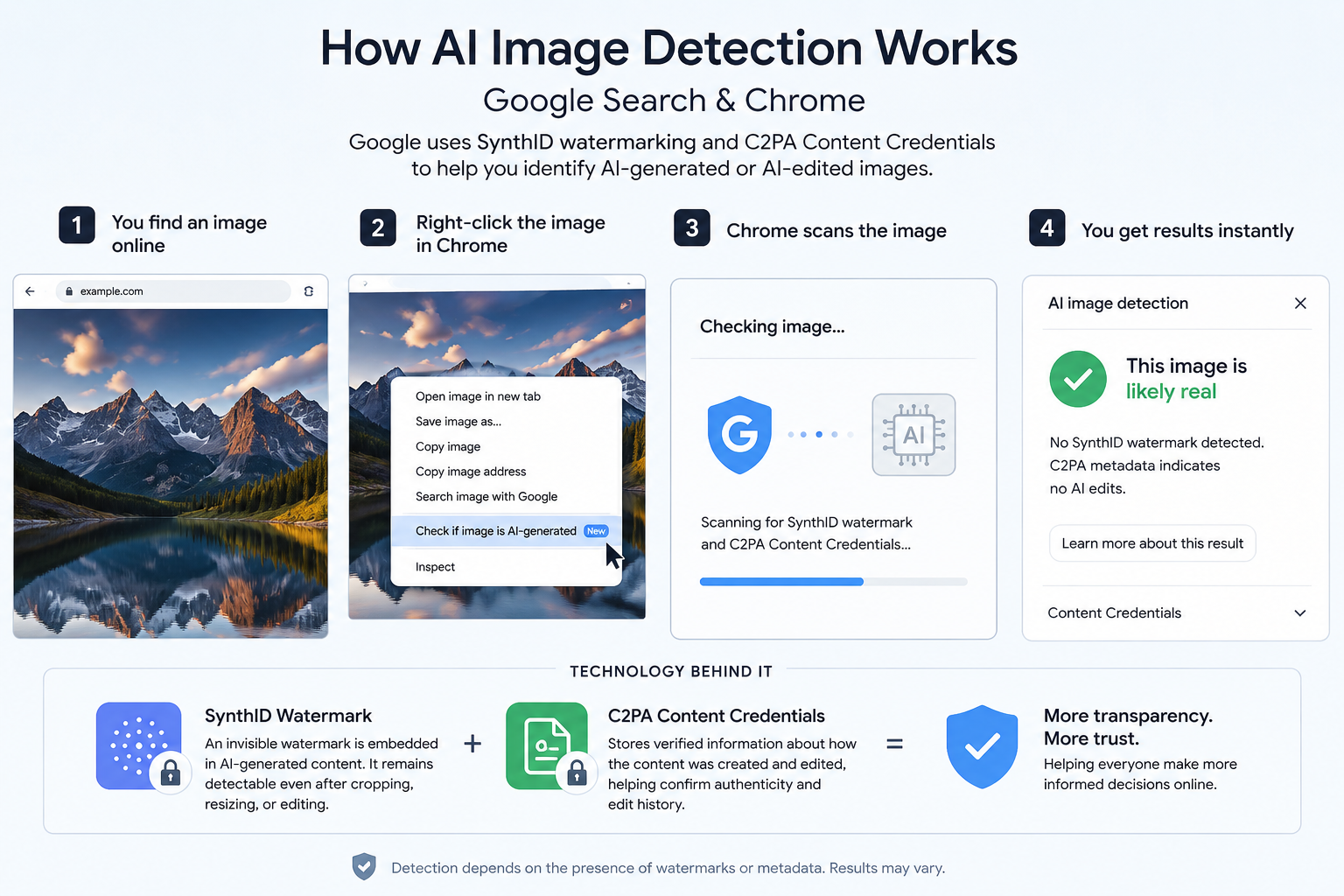
Google has announced a significant step in the fight against fake images, deepfakes, and deceptive AI content. At Google I/O 2026, the company announced that it will incorporate AI content verification into everyday tools such as Google Search and Chrome. The system uses Google DeepMind’s SynthID watermarking technology and C2PA Content Credentials to help users determine whether an image, video, or audio file was created or edited by artificial intelligence. According to Google, SynthID verification has already been used 50 million times globally in the Gemini app, and the company is now bringing this capability to Search and Chrome.
This update is necessary because the internet is entering a dangerous visual age. A photograph once carried a sense of proof. Now, a realistic image can be created in mere seconds. A fabricated image of a politician, a celebrity, a war zone, a protest, or a disaster can spread faster than the truth. Google’s new move aims to put a small torch in the hands of ordinary users, allowing them to verify what they see before believing it.
What Google has announced
Google announced that it is expanding its content verification system from the Gemini app to Google Search and Chrome. Users will have more options for checking content in Search, in addition to the existing discovery tools. Verification support for Chrome is expected to arrive in the coming weeks. Google’s official blog states that the goal is to make it easier for people to learn more about the content they encounter online.
According to The Verge, Google is bringing AI content verification to Chrome and Search, including support for SynthID and C2PA Content Credentials. According to the report, users can verify AI-generated images using Google Lens, Circle to Search, and AI Mode. Chrome integration will allow users to inquire whether an image is AI-generated directly from the browser.
This means that image verification is transitioning from a specialized tool to a common habit. Instead of downloading an image and checking it elsewhere, users will receive verification within the sites where they already search, browse, and investigate.
What is SynthID?
Google DeepMind developed SynthID, a digital watermarking technology. It incorporates an undetectable signal into AI-generated content. Although the watermark is invisible to the naked eye, SynthID’s technology can detect it. According to Google DeepMind, SynthID can work with images, audio, text, and video files. (Google’s DeepMind)
In 2023, Google DeepMind introduced SynthID for artificial intelligence-generated images. At the time, DeepMind explained that SynthID embeds a digital watermark directly into an image’s pixels, rendering it invisible to humans but detectable for identification.
This is unlike a visible watermark. A visible watermark can be cropped, blurred, or completely removed. SynthID operates as a hidden fingerprint within the content. It does not raise its voice above the ground. It quietly remains within the file and assists verification tools in detecting AI involvement.
How it works for users.
The basic idea is that when a user encounters a suspicious image online, Google wants them to check it in Search, Chrome, Google Lens, or Circle to Search. SynthID watermarks and C2PA Content Credentials are examples of signals that the tool looks for. If those signals exist, the user will have a better understanding of whether the content was created or edited by AI.
According to Google’s official blog, SynthID verification for images, videos, and audio was recently added to the Gemini app and has been used 50 million times globally. Google is now extending that functionality to Search and Chrome.
According to the Verge, the new interface will combine SynthID and C2PA markers, allowing users to see verification details in one place. It also stated that the service is currently focused on images, with expanded support for video and audio planned via Google’s verification ecosystem.
This simplifies the verification process for everyday users. A person encounters a viral image. The image appears genuine. Instead of reacting immediately, the person examines it. That pause can shield public discourse from panic, hatred, and manipulation.
Why is this update important?
This update is significant because AI-generated media has become overly realistic for human eyes. A fabricated image now includes shadows, skin texture, lens blur, emotion, and background detail. It can resemble a genuine photograph taken in a real location. This poses a significant challenge for journalism, politics, elections, social media, and public safety.
Fake images can be damaging to a person’s reputation. They have the potential to heighten communal tensions. They have the potential to instill false fear during disasters. They may deceive voters. They are capable of disseminating fabricated war scenes. They can also be used to commit fraud, blackmail, and spread propaganda.
Google’s decision is significant because Search and Chrome are not small products. They are positioned in the center of the web. When verification is integrated into these tools, AI detection becomes more accessible to regular people, not just researchers and experts.
It is also important for journalists. Reporters frequently have to work under pressure. A viral image appears. People want to know if it is true. Newsrooms require expedited verification. A built-in tool does not replace reporting; rather, it provides journalists with one more checkpoint before publication.
Importance to India and Global Users
India is one of the world’s biggest internet markets. Viral images spread quickly via WhatsApp, Facebook, Instagram, YouTube, X, and local language news pages. Fake images can have serious consequences during elections, communal incidents, protests, floods, accidents, and celebrity controversies.
A built-in AI image checker assists Indian users, journalists, students, creators, and fact-checkers. It also aids local language media, which spreads misinformation through emotional captions and edited visuals. The more verification becomes a part of daily browsing, the more difficult it is for fake content to spread without challenge.
The same issue is visible all over the world. AI images influence elections, business news, financial rumours, war reporting, and celebrity culture. A single fake image can sway public opinion before the truth is discovered.
The Function of C2PA Content Credentials
Google isn’t just relying on SynthID. It also accepts C2PA Content Credentials. C2PA is an industry standard that stores information about how content was created and edited. It can determine whether a file came from a camera, if it was edited, and whether generative AI was used.
According to The Verge, Google is combining SynthID and C2PA verification in search and Chrome. It also stated that Meta is experimenting with C2PA labeling on Instagram, while other companies are collaborating on larger content authenticity efforts.
This is significant because a single company cannot solve the fake media issue. AI content is distributed across multiple platforms, apps, devices, and websites. A verification standard is only effective when a large number of companies participate.
Drawbacks and constraints
The biggest disadvantage is that detection is dependent on cooperation. SynthID works best when content is generated by systems that include a watermark. SynthID alone cannot identify a harmful fake image generated by a tool that does not add a watermark.
There are flaws in C2PA as well. According to The Verge, C2PA metadata can be stripped when images are uploaded to social media or captured as screenshots. This means that a verified history can vanish as content travels the internet.
The lack of user trust is another disadvantage. Some people will believe only what supports their beliefs, even if a tool provides warning signs. Technology can provide signals, but it cannot compel people to accept the truth.
There is also the risk of misplaced confidence. If an image lacks a watermark, it does not necessarily indicate that it is authentic. It simply means that the system did not locate that specific signal. Users and journalists continue to require reverse image search, source confirmation, location verification, timestamp analysis, and human reporting.
The future impact
The future of online verification is expected to include built-in truth signals. Search engines, browsers, social media platforms, cameras, and AI tools are all beginning to store origin information. Users will soon expect to know whether an image was captured by a real camera, an AI model, or a combination of the two.
Google DeepMind claims that SynthID has been used to watermark over 100 billion images and videos, as well as 60,000 years of audio, in its generative media models and products.
The internet’s direction is shown on this scale. Artificial intelligence content is not a small wave. It is transforming into an ocean. Verification tools will be as essential as antivirus software, spam filters, and fact-checking systems.
This gives journalists a new professional responsibility. Visual verification will have to be treated as part of basic reporting. A photo will not be accepted simply because it appears to be emotionally charged. It will be necessary to conduct source, context, and technical checks.
Ordinary users should make it a habit to check before sharing anything. Check before taking action. Before making an accusation, check. Truth’s future is dependent on discipline as well as tools.
Conclusion
Google’s decision to bring AI image detection into Search and Chrome is one of the most important moves in the fight against deepfakes and AI misinformation. It does not solve the whole problem, but it brings verification closer to the public.
SynthID gives AI-generated content a hidden fingerprint. C2PA adds a record of creation and editing. Together, they create a stronger path toward digital transparency. The system has limits, especially when content comes from tools that do not support watermarking or when metadata is removed. Still, this update changes the direction of the internet. It tells users that seeing is no longer enough. Checking is now part of seeing.
Disclaimer
This article is based on public information available from Google, Google DeepMind, The Verge and related technology reporting as of May 21, 2026. Details about product rollout, supported regions and interface behavior can change as Google updates Search, Chrome, Gemini, and related tools. AI detection tools are helpful, but no system gives perfect proof in every case. Users should verify sensitive images through multiple sources before sharing or publishing them.